News & Updates
Latest news and updates from the DS4DH group.
Boya Zhang successfully defends her PhD thesis

Congratulations to Dr. Boya Zhang, who successfully defended her PhD thesis, Your Health Questions Answered by Reliable Language Models, on 2 September 2026 at Campus Biotech in Geneva. Boya was a candidate for the Doctorat ès sciences en Sciences de la vie of the Faculties of Medicine and Science of the University of Geneva, with a specialisation in Genomics and Digital Health, and carried out her research within the DS4DH group under the supervision of Prof. Douglas Teodoro at the Department of Radiology and Medical Informatics. Her thesis addresses a vital challenge in modern healthcare AI: assessing the quality of health information and mitigating hallucination in large language models. Along the way, she developed methods and open benchmarks that advance how language models retrieve health information, verify clinical claims, and reason through conflicting biomedical evidence:
- Multi-dimensional information retrieval: a retrieval approach that ranks online health information not only by query-document relevance, but also by its usefulness, supportiveness and credibility, showing that combining these information quality dimensions increases the helpfulness of health search results (JMIR AI, 2024).
- CliniFact: a scientific claim verification benchmark derived from hypothesis testing results in clinical research, comprising 1,970 claim-evidence instances from 992 clinical trials linked to 1,540 publications, designed to evaluate how well language models assess clinical research claims (Scientific Data, 2025).
- HealthContradict: an expert-verified benchmark of 920 instances pairing health questions with contradictory documents, which quantifies how language models behave under biomedical knowledge conflicts and whether they can exploit correct context while resisting incorrect context (npj Digital Medicine, 2025).
Beyond her scientific contributions, Boya's sharp intellect, boundless energy and generous team spirit have deeply enriched our lab, and supervising her has been a pleasure both scientifically and personally. The whole DS4DH team celebrated this milestone together with her and looks forward to the remarkable trajectory ahead. Congratulations, Dr. Zhang!
ARGENTIC Kick-off
The DS4DH group recently participated in the official kick-off meeting for ARGENTIC, a newly launched, European-funded project designed to develop agentic AI systems that operates across the Cloud–Edge–IoT continuum. Moving away from centralized and resource-heavy AI models, ARGENTIC is developing a modular, decentralized architecture. The project leverages autonomous AI agents powered by lightweight Small Language Models that run directly on edge devices. During the kick-off meeting, the consortium aligned on the project's overall organization, established key timelines and upcoming milestones, and began diving into the core technical specifications. Our lab is playing a pivotal role in two major areas of the project:
- The Knowledge & Data Fabric Layer: We are leading the development of Local Knowledge Graphs and memory embeddings, which will give individual AI agents the localized context they need to make smart, autonomous decisions.
- Clinical Validation: In collaboration with the University Hospitals of Geneva (HUG), we are leading a high-stakes healthcare use case. We will develop bedside AI agents capable of monitoring multimodal vital signs, including ECG, SpO₂, heart rate, and blood pressure, echocardiograms, in real time.
By embedding trustworthy, distributed intelligence directly at the point of care, our team is helping realize ARGENTIC’s vision of human-centric, strategically sovereign AI that delivers fast, reliable support for patient outcomes.
AIM-SAFE Kick-off

Our lab recently participated in the kick-off meeting of AIM-SAFE, a European-funded project dedicated to reducing medication-related harm and supporting clinicians through a modular, privacy-preserving AI Safety Co-Pilot.
With medication errors contributing to an estimated 200,000 annual deaths in Europe, AIM-SAFE addresses a critical healthcare challenge. The project leverages a multi-agent architecture powered by lightweight Small Language Models to provide traceable, evidence-based clinical recommendations. To protect sensitive patient data, the system utilizes a federated learning framework, ensuring information remains securely within hospital infrastructures.
The kick-off meeting focused on project organization, short-term objectives, and initial technical specifications. A major highlight was a series of dedicated, collaborative workshops:
- Work Package Workshops: Partners aligned on early operational steps, analyzing data requirements, formatting, potential modeling approaches, and interpretability.
- Ethics Workshop: All partners participated in a joint session focused on "embedded ethics", establishing a framework to integrate ethical considerations into the AI models from the very beginning of development.
Our lab is taking on leadership roles within the project's technical and clinical tracks:
- Predictive Modeling Leadership (WP4): We lead Work Package 4, focusing on personalized predictive modeling for prescribers and hospital pharmacists. Our team is designing core models that analyze heterogeneous clinical data to anticipate patient-specific risks and support personalized medication management.
- Clinical Communication (T6.2): We lead Task 6.2 to develop a dynamic deprescribing and communication agent. This agent will generate clear, natural-language explanations and evidence-backed recommendations to facilitate shared decision-making between clinicians and patients.
Our efforts are central to advancing three primary clinical use cases within the project:
- High-Risk Medication Identification: Automatically flagging medications suitable for tapering or discontinuation based on patient comorbidities, frailty, and clinical profiles.
- Safe Medication Prioritization: Assessing individual risks and benefits to support safe, evidence-based deprescribing decisions.
- Phenoconversion Risk Prediction: Integrating multi-drug interactions, patient comorbidities, lifestyle factors, pharmacogenomics, and tumor characteristics to anticipate adverse drug reactions.
By reducing the cognitive burden on healthcare professionals and improving prescribing safety, particularly for older adults and vulnerable populations, our team is proud to contribute to AIM-SAFE’s vital mission
CTRAI2 project kick-off
We want to share with you the launch of CTRAI2 – AI-based Risk Assessment for Clinical Trials on Medicinal Products: A Large-Scale and Integrative Approach, whose kick-off meeting was held on 15 April 2026. Supported by the Swiss National Science Foundation (project funding, CHF 727,500) for the period April 2026 – March 2030, CTRAI2 is jointly led by Prof. Douglas Teodoro (PI, Data Science for Digital Health, Faculty of Medicine, UNIGE) and Prof. Caroline Samer (co-PI, Division of Clinical Pharmacology and Toxicology, HUG and UNIGE).
Clinical trials remain a cornerstone of drug development, yet they are costly and frequently affected by high failure rates. CTRAI2 will develop an integrative AI-based framework for the joint assessment of safety, efficacy and operational risks in clinical trials, building on a large-scale benchmark dataset derived from trial protocols, results and related biomedical sources, together with deep learning models tailored to this setting. By bringing together clinical pharmacology and data science expertise, the project aims to contribute to more reliable risk prediction, improved trial design and safer, more efficient drug development. The resulting benchmark data and models will be released as open resources, in support of further research on digital trials and AI-assisted clinical research.
AIM-SAFE: a new European project awarded to DS4DH under the GenAI4EU call
We are pleased to announce that our group has been awarded a new project under the Horizon Europe GenAI4EU call "Leveraging multimodal data to advance Generative Artificial Intelligence applicability in biomedical research". AIM-SAFE — A Multi-Agent Framework for Safe, Specialised, and Adaptive Clinical Reasoning was initiated and structured by the DS4DH group and brings together a consortium of 25 institutions across 14 countries, with a total budget of €16.7 million (€1.73 million allocated to the Geneva teams). The project is co-led at the University of Geneva by Prof. Douglas Teodoro (Department of Radiology and Medical Informatics, Faculty of Medicine) and Prof. Caroline Samer (Director of the Department of Anaesthesiology, Pharmacology, Intensive Care and Emergency Medicine, and Head of the Division of Clinical Pharmacology and Toxicology at the HUG).
AIM-SAFE will develop a generative AI-based clinical decision support framework relying on specialised agents able to analyse complex biomedical data in order to predict adverse drug events, identify deprescribing opportunities, integrate pharmacogenomics into therapeutic decisions, and optimise dosing regimens — with a particular focus on polymedicated and oncology patients. Our group will lead the development of personalised predictive models, based on small language models and agentic technologies, for prescribers and clinical pharmacologists, while clinical validation across European hospitals will be coordinated by Prof. Samer together with Dr Aurélien Simona (HUG). Beyond its clinical ambitions, AIM-SAFE aims to contribute to a reliable, explainable and privacy-preserving European medical AI, fully compliant with the GDPR, the AI Act and the European Health Data Space.
ARGENTIC: a new European project for trustworthy agentic AI in healthcare
We are glad to inform that our group will co-lead the healthcare pillar of ARGENTIC (Agentic Reasoning for the Generative AI-Enabled Cognitive Continuum), a Horizon Europe project awarded under the Empowering AI/GenAI along the Cognitive Computing Continuum call. The consortium brings together 19 institutions across 9 countries, with a total funding of €7.5 million. ARGENTIC aims to build a sovereign, trustworthy and energy-efficient European ecosystem for agentic AI, deployable from the cloud down to connected devices at the point of care. The project combines federated learning, knowledge graphs and digital twins to enable collaboration between institutions without sharing raw data, in line with the AI Act and the GDPR.
At the UNIGE Faculty of Medicine, the project is led jointly by Prof. Douglas Teodoro (Department of Radiology and Medical Informatics) and Dr Elena Tessitore (HUG, Division of Cardiology), under the umbrella of the recently established Geneva Centre for Cardiac and Vascular Research (GCCVR). The Geneva teams will drive the healthcare pilot, which consists in deploying lightweight AI agents, based on sovereign language models, directly on bedside monitoring devices. The goal is to analyse vital signs such as ECG, heart rate, blood pressure and oxygen saturation in real time, in order to detect early signs of arrhythmia or cardiac decompensation, while ensuring that patient data never leave the hospital.
WHO-DS4DH collaboration kick-off
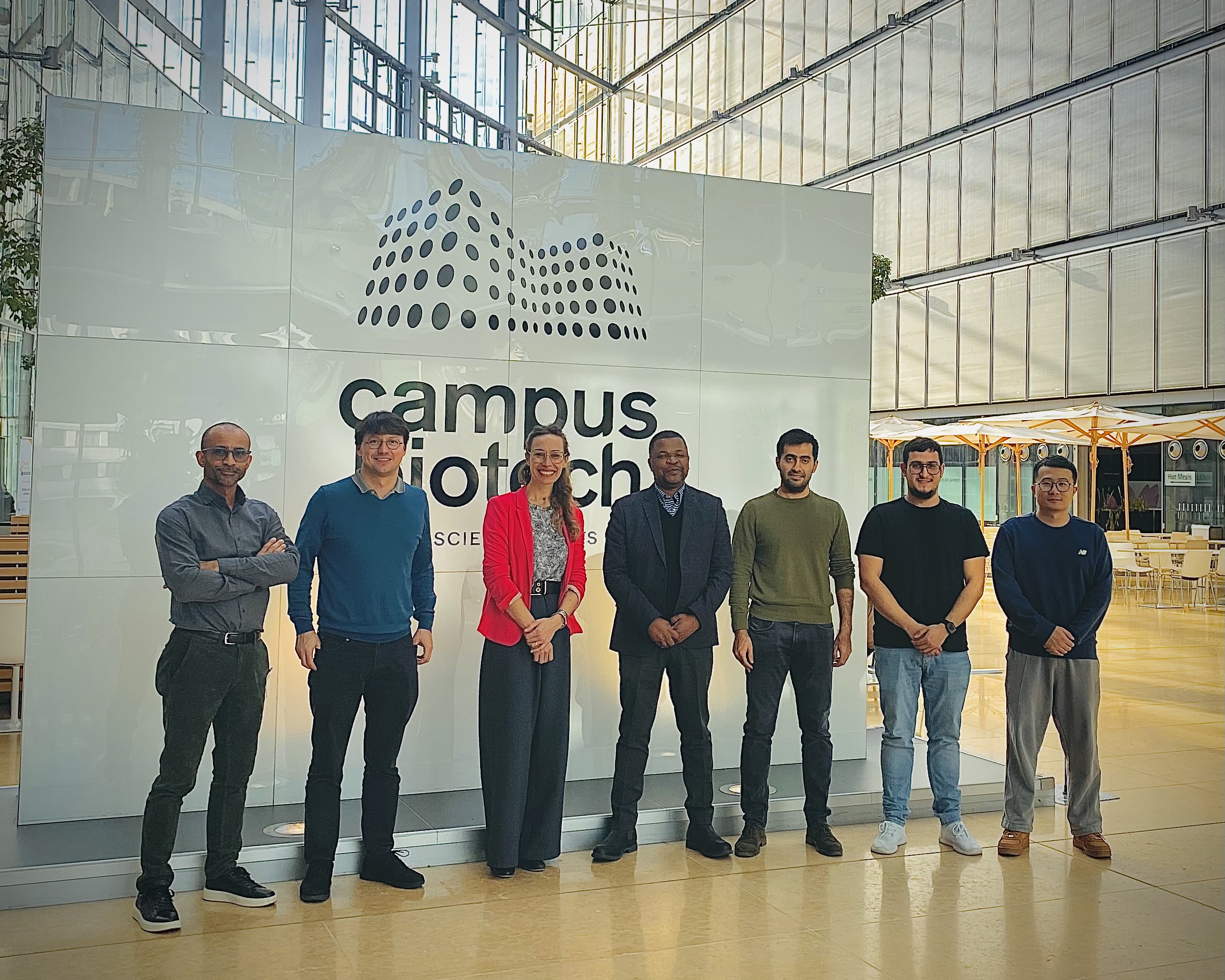
DS4DH is happy to share that the kick-off meeting for the project "Automating the triage of incident reports to the WHO’s GSMS platform using Machine Learning" took place on 13 January 2026, together with the World Health Organization (WHO). The project aims to support incident management in the WHO Global Surveillance and Monitoring System (GSMS) by using machine learning to help prioritize incident reports for faster review.
CT-DEB'26 Shared Task
We are excited to announce the launch of CT-DEB’26, an open challenge hosted on CodaBench. This is an invitation to the ML and healthcare communities to develop predictive models for medication and dosing error risk in interventional clinical studies.
DS4DH joins AI Hub

We are thrilled to announce that DS4DH Joined "Le Pôle IA est le pôle genevois d’innovation en intelligence artificielle appliquée aux soins, à la santé et aux neurotechnologies" located at Campus Biotech.